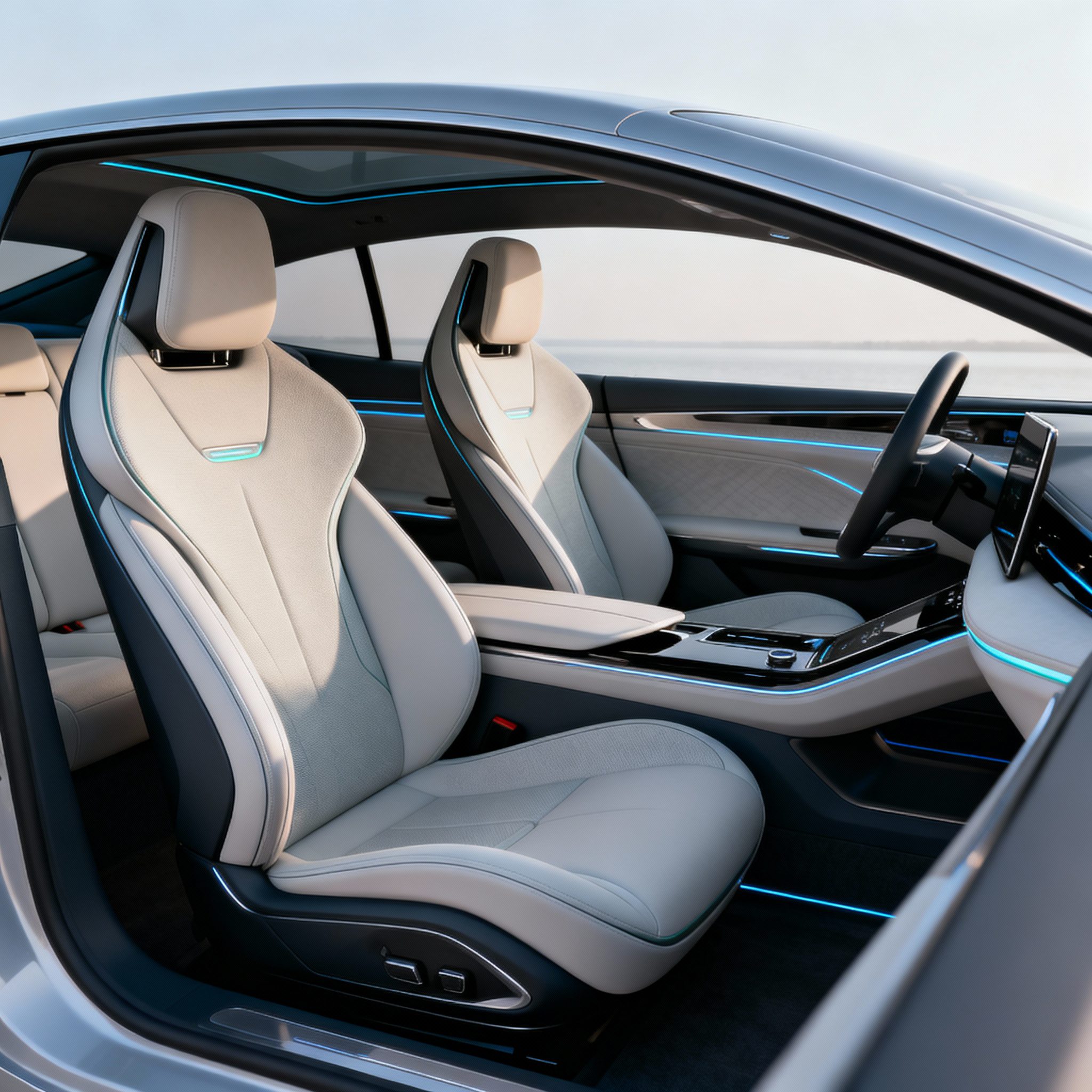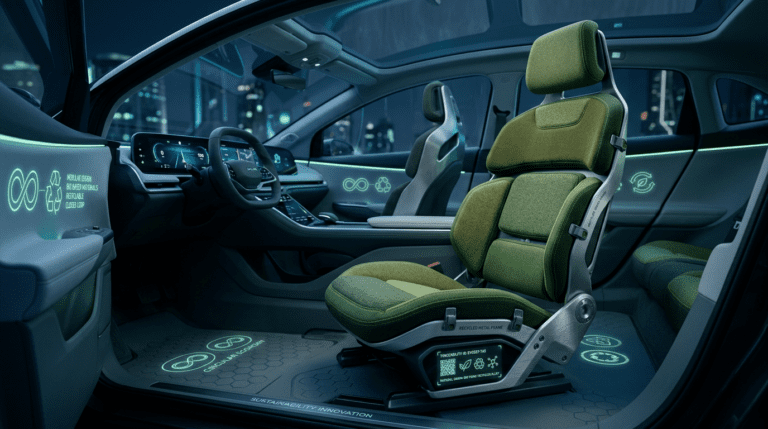
The automotive seating industry faces a pivotal shift as circular economy principles demand smarter, greener designs. Beyond traditional metrics, forward-thinking engineers must now prioritize parameters like recyclability, material renewability, lifecycle extension, and planetary impact. This is to ensure seats not only perform today but regenerate resources tomorrow.
Emerging Design Parameters
Future seat architectures hinge on holistic evaluation across expanded criteria.
- Recyclability Index: Ease of disassembly and material purity to enable closed-loop reuse, minimizing landfill waste.
- Carbon Footprint Score: Total emissions from raw materials to end-of-life, favoring bio-based over fossil inputs.
- Modularity Quotient: Interchangeable components for upgrades, repairs, and reconfiguration without full replacement.
- Resource Efficiency: Reduced mass and parts count to cut manufacturing complexity while boosting EV range.
These parameters integrate with classics like mass, cost, performance, comfort, usability, seating arrangements, and manufacturing feasibility for comprehensive benchmarking.
How a Simple Database Unlocks Superior Designs
We at ASPL have built a thorough and exhaustive system of benchmarking and engineering development process to improve the quality of engineering design and decision making. A streamlined automotive database transforms complexity into clarity by comparing designs across all key metrics in instantly.
Our global studies of structures at AllAbout Seats exemplifies this: input project needs—target mass under 20kg, cost below $150/unit, high comfort scores—and it reveals top benchmarks. It weighs trade-offs instantly: a modular bio-foam seat might excel in recyclability and lifecycle (95% reusable) but trade slight cost for 15% lower CO2.
| Parameter | Traditional Seat | Future Modular Seat | Database Insight |
|---|---|---|---|
| Mass | 25kg | 21kg (-16%) | Flags lightweight winners |
| Cost | $140 | $155 | Balances with lifecycle savings |
| Parts Count | 45 | 22 (-51%) | Simplifies mfg complexity |
| Recyclability | 60% | 95% | Prioritizes circularity |
| Comfort/Usability | High | High+ (adaptive) | Scores multi-use arrangements |
| CO2 per Unit | 80kg | 42kg (-48%) | Tracks full sustainability |
Practical Impact
Design professionals and teams using such databases select proven architectures 3x faster, avoiding trial-and-error. For instance, right parameter and MUST have will take precedence over traditional approval. Our Database and team might recommend a low-parts-count frame for compact EVs, optimizing seating flexibility for autonomy while hitting performance targets.
AllAbout Seats’ exhaustive system & engineering goes further, curating real-world data to define the right benchmark every time—empowering you to lead in sustainable innovation.Lets connect and design the future, parameter by parameter.